On this page
The limitation that surprises most owners isn’t the price of a good restraint — it’s finding out that the vast majority of “car safety” harnesses sold online have never been crash tested at all.
I’ve spent a lot of exam-room minutes on this exact question, usually after a client mentions a fender-bender and asks, almost as an afterthought, whether their dog was okay. Most of the time the dog was fine because it happened to be in a crate wedged behind the seats. A few times it wasn’t fine, because a 60-pound dog rode 25 mph faster than the car did the moment the brakes engaged, and there was nothing between the dog and the windshield. That’s the physics I lead with before we ever talk product.
Myth versus reality: what “crash tested” actually means
Most pet product packaging that says “tested” is describing a static pull test, not a dynamic crash test. Those are very different things. A static test checks whether webbing tears under steady tension; it says almost nothing about what happens when a harness, crate, or barrier absorbs the sudden deceleration of a real collision. The organization that has actually done dynamic sled testing on dog restraints is the Center for Pet Safety, a nonprofit that partnered with Subaru and an NHTSA-contracted lab, MGA Research Corporation, to run crates, carriers, and harnesses through the same kind of crash sleds used for child car seats.
Their findings were not close to uniform across the category. In the 2015 crate study, the Gunner Kennels G1 Intermediate, secured with its own tie-down straps, held together under forces that caused other crates to buckle, crack, or come loose entirely. That distinction matters more than brand loyalty: a crate that isn’t rated for crash forces is functionally a projectile with your dog inside it.
Seat belts and harnesses: what actually holds
A seat belt-style restraint is really a harness clipped into the vehicle’s existing seat belt system, and the harness itself is doing all the work. In Subaru U.S. Media Center: Subaru and Center for Pet Safety’s joint crash testing, many popular harnesses failed catastrophically on the sled — straps ripped from the D-ring, buckles released, or the dog was thrown forward far enough to reach the front seats. A small number performed well enough to be named honorees. The difference usually came down to a wide, load-distributing chest panel and a metal-reinforced connection point, rather than a single stitched loop of webbing.
For dogs under roughly 25 pounds, a well-built harness clipped short enough to prevent the dog from reaching the front seat is a reasonable everyday choice, and it’s the option most of my clients with smaller dogs actually use consistently, which counts for something — the safest restraint is the one that gets used every single drive, not the one sitting unused in the trunk.
Crates: the highest ceiling, if the crate earns it
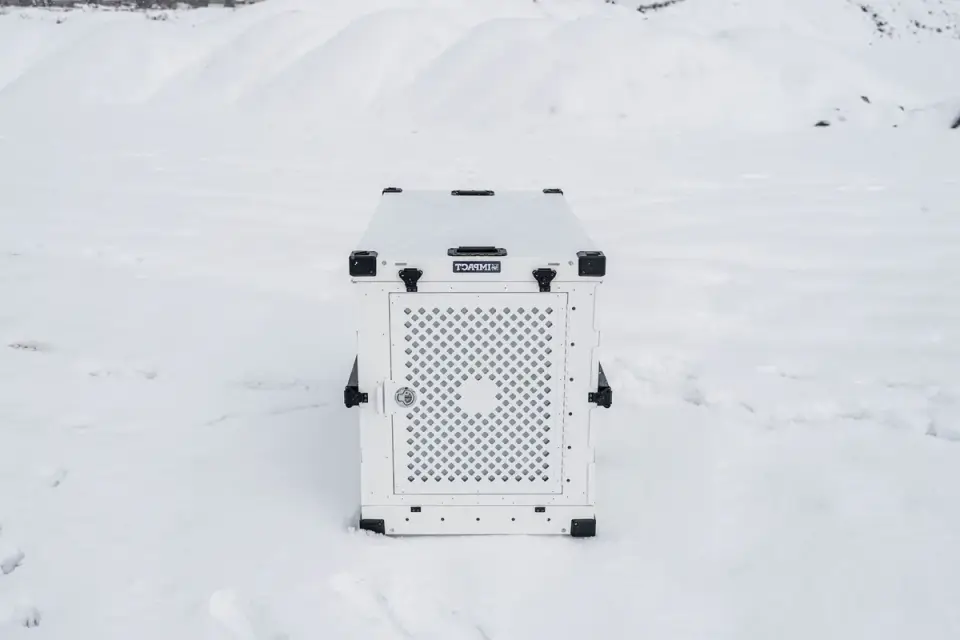
A rigid, well-anchored crate is the restraint that scores best in dynamic crash testing, but only when two conditions are met: the crate itself is built to hold structural integrity under crash forces, and it’s tied down so it can’t become a loose object during impact. A crate that simply sits on the back seat or in an open cargo area, unsecured, defeats the entire purpose — it becomes a heavy projectile in a hard stop, which is worse than no crate at all for everyone in the car.
I worked with a family driving a mid-size SUV with a 70-pound Labrador they were determined to crate for road trips after a close call on the highway. The dog, Otis, was four years old and had never ridden in anything but the open cargo area, and the owners had noticed him sliding into the seatbacks on hard braking for months before they mentioned it to me. We measured the cargo space, sized a crate that left him room to stand and turn but not slide, and worked out tie-down anchor points using the vehicle’s cargo hooks rather than relying on friction alone. It took two trips to get him comfortable settling in it before the car started moving, but by the third week he walked in and lay down without being asked. That’s the sequence that actually works — size, anchor, then acclimate — and skipping the acclimation step is the most common reason owners abandon a crate that would otherwise have protected their dog.
Barriers: what they solve and what they don’t
A cargo barrier, mesh or metal, keeps a dog out of the front seat and out of the driver’s lap, and that’s a genuinely valuable job — distraction is its own crash risk, and a dog climbing into a driver’s lap is a documented contributor to loss of vehicle control. But a barrier does nothing to keep a dog from being thrown around within the space it does allow. It’s a containment tool, not a restraint in the crash-test sense, and it should be paired with a crate or harness behind it for a dog riding in open cargo space, not treated as a stand-alone safety solution.
The sequence I actually recommend
Start with your dog’s size and your vehicle’s layout, not the product page. Under about 25 pounds riding in the back seat, a crash-tested harness clipped short to the seat belt anchor is a sound daily option. Larger dogs, or any dog riding in an SUV’s cargo area, do better in a crate that has actual crash-test data behind it and is tied down to the vehicle rather than left to slide. If your dog rides loose in cargo space at all, add a barrier so a sudden stop doesn’t send them into the front seats — but don’t let the barrier be the only thing standing between your dog and the windshield.
Awareness of the risk is already high and hasn’t translated into consistent use. A 2010 AAA survey found that more than 80% of drivers recognized the dangers of driving with an unrestrained pet, yet only 16% actually used any kind of restraint. That gap is where most of the risk in this whole category actually lives — not in the difference between a good harness and a good crate, but in the drive nobody restrained the dog for at all.
Where I land, and the honest trade-off
If I’m recommending one default for most dogs riding in an SUV or wagon, it’s a crash-tested crate, tied down, sized to the dog. It has the best track record in dynamic testing and it protects against the failure mode — a loose object in a crash — that hurts everyone in the vehicle, not just the dog. The trade-off is real: a good crate takes up more space than a harness, costs more, and takes longer to introduce to a dog who’s never used one. A harness is faster to adopt and works fine for smaller dogs riding in a back seat with a short tether. The counterargument I hear most is that a dog seems calmer loose in the car, and sometimes that’s even true in the moment — but calm and safe aren’t the same thing, and a sled test doesn’t care how relaxed the dog looked five minutes before impact.
One more thing worth doing before any long drive: read up on the basics of road-tripping with a dog at Getting Started With Dog Travel: A Practical Prep Guide, since restraint choice is only one piece of a trip that goes smoothly.
What would change your mind about the restraint you’re using now — the data, or watching your dog actually ride in one?
Frequently asked questions
Is a dog seat belt as safe as a crate?
It depends on the dog's size and the harness. Crash-tested harnesses can work well for smaller dogs in the back seat, but dynamic testing from the Center for Pet Safety has shown large differences in performance between harness models, so the specific product matters more than the category.
Do I need a barrier if my dog already rides in a crate?
No — a properly anchored crate already contains the dog. Barriers are most useful for dogs riding loose in a cargo area without a crate.
How do I know if a crate is actually crash tested?
Look for a manufacturer that references independent dynamic sled testing, such as studies conducted with the Center for Pet Safety, rather than a static pull-test claim on the packaging.
Sources
- 2015 Crate Study Results — Center for Pet Safety
- Subaru of America and Center for Pet Safety Studies Showcase Promising and Shocking Crash Test Results of Pet Crates and Carriers — Subaru U.S. Media Center
- What You Need to Know About Dog Car Restraints — AAA