
On this page
The limitation that surprises most first-time travelers isn’t the pet fee or the weight limit. It’s that a hotel room is, from your dog’s point of view, a small unfamiliar box full of new smells, closed doors, and strange footsteps in the hallway — and etiquette problems almost always start there, not with bad manners.
I’ve spent a lot of exam-room time walking clients through why a normally easygoing dog barks at every hallway noise on night one of a trip, or won’t settle until 2 a.m. in a rental. It isn’t defiance. A dog that’s never been in that room before doesn’t have the baseline information a home environment gives for free — the layout, the usual sounds, who’s allowed to knock. Etiquette, at its core, is managing that unfamiliarity so your dog isn’t the one absorbing the stress of your trip.
The myth: good etiquette is about training your dog to behave
The common assumption is that a well-mannered travel dog is simply a well-trained one — sit, stay, quiet on command. Training helps, but it’s not the whole story. Most of the etiquette failures I hear about — barking at the ice machine, scratching at the door, an accident on unfamiliar carpet — trace back to a dog that’s over threshold on stress, not a dog that lacks commands. VCA Animal Hospitals lists panting, lip licking, pacing, and an inability to settle as common stress indicators, and those are exactly the behaviors that get flagged as “poorly behaved” by a front desk or a rental host. The dog isn’t misbehaving. It’s stressed, and stress reads as bad manners to anyone who doesn’t know what to look for.
The reality is that etiquette starts before check-in, with how you set the room up and how closely you read your dog once you’re inside it.
Before you book: what actually matters
A few things are worth confirming ahead of time rather than discovering at the front desk, and this is where How to Find Truly Pet-Friendly Hotels (Not Just Pet-Tolerant Ones) is worth a read if you haven’t already — a lot of “pet-friendly” listings mean “pet-tolerated for a fee, with restrictions.” Ask directly about weight limits, breed restrictions, whether dogs can be left alone in the room, and whether there’s a size limit for stated “small dog” policies. If cost is a concern, Hotel Pet Fees: What to Expect and How to Budget covers the range you should expect to see and how it’s usually structured.
One distinction that trips people up: emotional support animals and service dogs are not treated the same way under the law. Under the ADA.gov: ADA, a service animal is a dog individually trained to perform a task related to a disability, and hotel staff may only ask two questions — whether the dog is required because of a disability, and what task it performs. They cannot ask for documentation, and a hotel cannot charge a pet deposit for a legitimate service animal. Emotional support animals, by contrast, do not qualify under the ADA’s definition, and most hotels are within their rights to treat them as pets subject to standard pet fees and restrictions. Knowing which category your dog falls into avoids an awkward conversation at check-in.
A practical arrival sequence
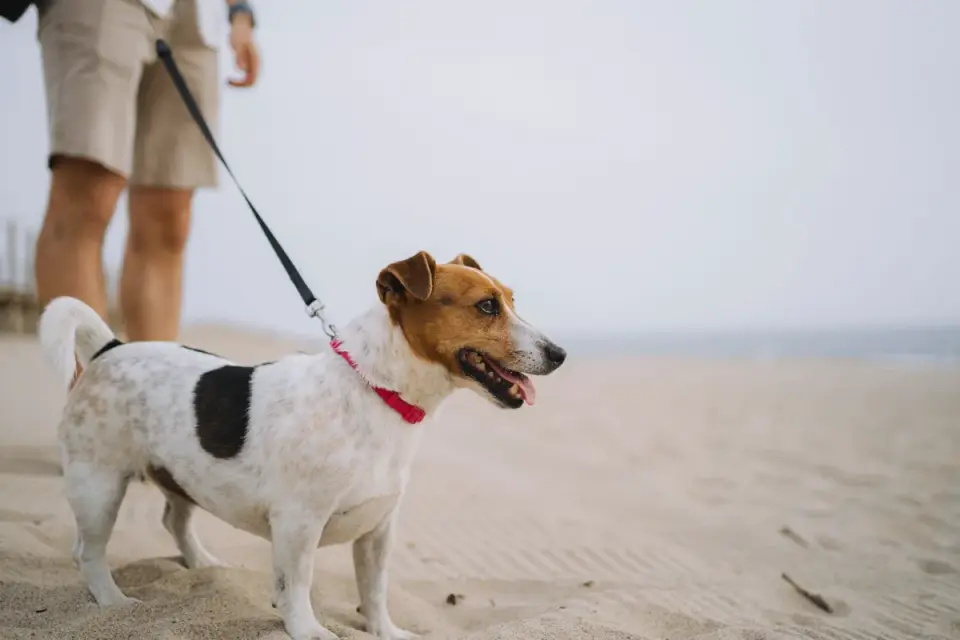
Here’s the order I recommend to clients, and it’s the same one I use with my own dog. Walk the dog before you go inside, even for two or three minutes — arriving with an empty bladder and a little of the travel edge worked off changes the first ten minutes in the room. Go straight to the room rather than lingering in the lobby; lobbies are loud, unfamiliar, and full of strangers reaching to pet a dog that’s already overstimulated. Once inside, do a quick walk-through with your dog on leash so it can sniff the corners and confirm there’s nothing alarming under the bed or behind the curtains — that short investigation does real work toward settling. Set up a familiar bed, blanket, or crate in a low-traffic corner, not the center of the room, and give the dog fifteen or twenty minutes before you expect calm.
One short piece of advice that’s easy to forget: don’t leave a dog you haven’t already tested for quiet-alone-time in an unfamiliar room while you go to dinner. A dog that’s fine alone at home may not be fine alone somewhere new, and barking complaints from neighboring rooms are the single most common etiquette failure hotels report to their pet policies. If you need a longer read on managing this specifically, How to Keep Your Dog Calm and Quiet in a Hotel walks through it in more depth.
I once worked with the owner of a three-year-old Cavalier King Charles Spaniel, about 16 pounds, who’d been fine on car trips but came home from a weekend hotel stay with soft stool and noticeably clingy behavior that lasted almost a week. The owner had left him alone in the room for a two-hour dinner on night one, and he’d apparently barked enough that the front desk called. Nothing was medically wrong — no fever, normal appetite by day three — but the stress load of a new environment plus unplanned isolation was enough to tip his gut and his behavior for days. We talked through a arrival routine for the next trip: a walk-through with him on leash, a familiar blanket, and no unsupervised alone time until at least the second day. On the next trip, the owner reported no incidents and a dog that settled within the hour. That’s one case, not a promise, but it’s the pattern I see often enough to build the sequence around it.
Hallways, elevators, and other guests
Etiquette outside the room is mostly about giving other guests and their dogs space and information. Keep your dog on a short leash in hallways and elevators — not the retractable kind, which is harder to control in tight quarters. If you see another dog in the elevator, it’s fine to wait for the next one rather than crowding two unfamiliar dogs together in a small box; most conflicts between traveling dogs happen in exactly that kind of forced-close-quarters moment. Centers for Disease Control and Prevention: CDC guidance on dogs notes that stress and unfamiliar situations are common contributors to reactive behavior, which is as true in a hotel corridor as it is anywhere else. If your dog is reactive to other dogs, tell the front desk — many will flag it discreetly for housekeeping or point you toward a service elevator during peak hours.
Rentals raise a slightly different set of manners: clean up thoroughly, including any accidents on carpet or hardwood, and don’t assume a fenced yard means off-leash freedom unless the host has explicitly confirmed it’s secure. A quick text to the host on arrival — “here with a well-behaved 40-pound dog, will keep off the furniture” — tends to smooth over a lot before it becomes a problem.
If your travels include a flight, the etiquette expectations shift again; Airline Pet Policies: What to Check Before You Book is worth reading well ahead of the trip, since airline documentation timelines are stricter than most hotel requirements.
Where I land, and the trade-off I won’t pretend away
My honest recommendation is to over-prepare on the arrival routine and under-promise on how independent your dog will be in a new space, at least for the first stay or two. The counterargument I hear most is that this is overkill for an easygoing dog who’s traveled plenty before — and for some dogs, it genuinely is. A well-traveled, low-anxiety dog may settle in five minutes flat with no walk-through needed. But I’d rather a client spend fifteen extra minutes on a dog that didn’t need it than skip the routine on a dog that did, because the cost of getting it wrong is a barking complaint, a damage charge, or a dog that’s miserable for the whole trip. That’s the trade-off, and it’s one I make on purpose.
Looking ahead, more hotels are formalizing pet etiquette into their booking flow — pre-arrival questionnaires, designated pet floors, specific walk routes — which should make a lot of this easier over the next few years. Until then, the routine above is the best tool you have.
Quick answers
Do I need to tell the hotel my dog has anxiety? It’s not required, but it helps. Front desks that know in advance can often offer a quieter room or floor, which reduces the odds of a stress-driven incident.
Can a hotel refuse my dog if it’s a certified service animal? No. Under the ADA, hotels must permit trained service dogs and cannot charge a pet deposit for them, though owners remain responsible for any actual damage caused.
Is it rude to bring my dog to the lobby or breakfast area? Check the property’s specific policy — many pet-friendly hotels restrict dogs from food-service areas for health code reasons even when the dog is otherwise welcome throughout the building.
Frequently asked questions
Do I need to tell the hotel my dog has anxiety?
It's not required, but it helps. Hotels that know in advance can often offer a quieter room or floor, which lowers the odds of a stress-driven incident.
Can a hotel refuse my dog if it's a certified service animal?
No. Under the ADA, hotels must permit trained service dogs and cannot charge a pet deposit for them, though owners remain responsible for any actual damage caused.
Is it rude to bring my dog to the lobby or breakfast area?
Check the property's specific policy — many pet-friendly hotels restrict dogs from food-service areas for health code reasons even when the dog is otherwise welcome elsewhere in the building.
Sources
- Dogs | Healthy Pets, Healthy People | CDC — Centers for Disease Control and Prevention
- Signs Your Dog is Stressed and How to Relieve It — VCA Animal Hospitals
- Service Animals and the ADA — ADA.gov