On this page
Three weeks. That’s the number I lead with when a client calls asking if their dog can still make the family trip. A dog’s heat cycle, or estrus, typically spans about three weeks of active signs, and it isn’t something you can shorten by rescheduling a flight or pushing back a hotel reservation. It’s a hormonal event, not an inconvenience you can plan around the way you’d plan around rain.
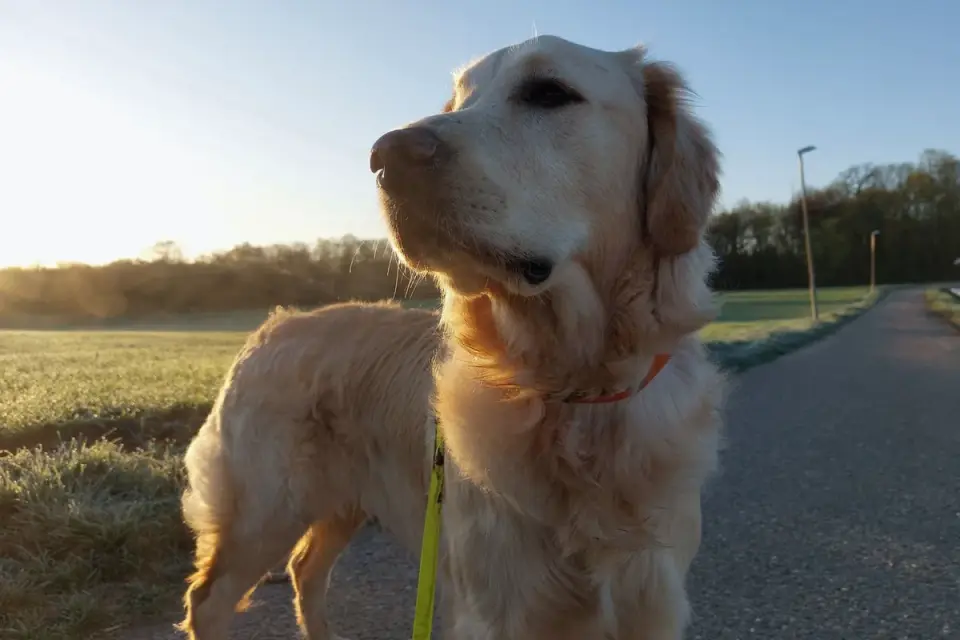
In my practice, I’ve had this exact conversation more times than I can count. One that stands out: a client with a 2-year-old unspayed Golden Retriever, about 55 pounds, had a beach week booked for late July. She noticed light spotting on the kitchen floor on a Tuesday morning and called me that afternoon, packing list still open on the counter. We talked through it — proestrus had clearly started, the dog was ten days from ovulation range, and the destination was a dog-friendly but fairly social beach town with off-leash areas. I didn’t tell her to cancel. I told her what the trip would actually look like: on-leash the entire time, no dog parks, no beach days packed with other unfixed males, and a plan for accidents in the car. She went. It worked, mostly because she went in with realistic expectations instead of hoping the cycle would just quietly resolve itself.
Myth: it’s just a mess to manage. Reality: it’s a hormonal window with real logistics
The instinct is to treat a dog in heat like a laundry problem — pack extra towels, maybe a doggie diaper, and go. That undersells what’s happening. During proestrus, rising estrogen brings vulvar swelling and bloody discharge, and — this is the part owners miss — she becomes attractive to male dogs well before she’s actually receptive to breeding. That phase runs roughly nine days but can range from three to three weeks, according to the American Kennel Club. Estrus itself, the fertile “standing heat” stage, follows for about another nine days.
The Cornell University College of Veterinary Medicine describes the fertile window as running from a couple of days before ovulation to about five days after — which means a dog can be genuinely breedable for close to a week in the middle of a cycle that outwardly looks the same from day one to day twenty. You can’t tell by eye where she is in that window. That’s the mechanism behind every practical rule that follows: leash management, distance from intact males, and lodging that won’t put her next to one.
Unspayed male dogs don’t need to see her to know she’s there. Females release pheromones during heat that males can detect from remarkable distances, and those signals tend to override normal recall and training. A well-behaved male at a rest stop or dog park can become a different animal entirely around a female in heat. That’s not a training failure on either owner’s part — it’s biology working exactly as designed.
The sequence I walk clients through before a trip
- Confirm timing first. Note the day discharge started and count forward. Nine days of proestrus, nine more of estrus is the rough average per VCA Animal Hospitals, though individual dogs vary. If you’re early in the cycle, you have more flexibility than if you’re already ten days in.
- Call ahead, every time. Airlines, hotels, and kennels each handle this differently, and none of it is standardized the way temperature restrictions are. The U.S. Department of Transportation notes that airlines can refuse to transport an animal that appears sick or distressed, and cargo carriers in particular may decline a dog in heat outright because of the stress and mess risk in a shared hold. Don’t assume; ask the specific carrier or property before you book.
- Boarding needs its own conversation. Not every kennel accepts a dog in heat, and the ones that do usually require a private run away from intact males rather than a standard shared kennel run. If you’re leaving her with a sitter or facility while you travel, say so at booking, not at drop-off.
- Pack for containment, not just comfort. A washable belly band or heat diaper, extra bedding, and a plan for frequent, closely supervised bathroom breaks matter more on a trip than they do at home, where you control the yard.
- Skip the off-leash stops. Dog parks, beaches with loose dogs, and busy trailheads are the wrong environment for this particular week, regardless of how well-trained either dog is.
If you’re traveling by car rather than air, the logistics get simpler but not trivial — the concerns in our packing list guide around bedding and cleanup apply directly here, and if you’re bringing a collapsible bowl setup, keep it separate from any bedding that touches discharge, for basic hygiene.
Where I land, and the counterargument I won’t dismiss
My recommendation: if you have flexibility, reschedule around the cycle rather than through it. Three weeks is a long window, but it’s a known and finite one, and most trips can absorb a shift of a few weeks better than they can absorb the logistics of managing an unspayed female in heat around strangers’ dogs.
The counterargument is real, and I don’t wave it off: sometimes there’s no flexibility. A move, a family emergency, a nonrefundable booking made before the cycle started — these happen, and “just don’t go” isn’t useful advice in that moment. In those cases, the trip is manageable with the sequence above; it’s just more work, and it requires you to be the one enforcing boundaries other owners won’t think to ask about.
One short truth I give every client on this call: the risk isn’t the mess. It’s an unplanned breeding or a fight between males, and both are preventable with distance and a leash.
I think about a Border Collie mix I saw a few years back, spayed shortly after an unplanned litter that happened during what her owner described as “just a weekend at a friend’s cabin, she was barely showing signs yet.” Nobody had asked whether an intact male would be at the cabin too. It was a fixable oversight, and it’s exactly the kind of gap a five-minute phone call before you leave closes completely. If you’re weighing a trip against a heat cycle, that’s the phone call to make first — not after you’ve already loaded the car.
Looking ahead, the calculus is easier if spay timing is part of your broader travel planning rather than an afterthought you deal with mid-cycle. If your dog isn’t already spayed and you travel often, talk to your vet about timing it around your calendar rather than around hers.
FAQs
Related reading if you’re mapping out the rest of the trip: our guides on traveling internationally with your dog and traveling with a puppy for the first time cover adjacent logistics worth checking before you book.
Frequently asked questions
How long does a dog stay in heat?
Most cycles run about three weeks total, with roughly nine days of proestrus followed by roughly nine days of estrus, though individual timing varies by dog, per the American Kennel Club.
Can male dogs really smell a female in heat from far away?
Yes — females release pheromones during heat that males can detect from a significant distance, which is why leash discipline and distance from intact males matter more than usual during this window.
Will airlines let me fly with a dog in heat?
Policies vary by airline and aren't uniformly published, so call ahead. Carriers can refuse transport for a dog that appears distressed, per the U.S. Department of Transportation, and cargo carriers in particular may decline outright.
Sources
- Everything You Need to Know About Dogs in Heat — American Kennel Club
- Dog estrous cycles — Cornell University College of Veterinary Medicine
- Estrous Cycles in Dogs — VCA Animal Hospitals
- Flying with a Pet — U.S. Department of Transportation