On this page
The limitation nobody mentions on the dealership tour
Everyone talks about hookups, generator noise, and slide-outs. Almost no one talks about what happens to a parked RV’s interior on a warm afternoon. That’s the gap that actually gets dogs hurt on RV trips, not the driving.
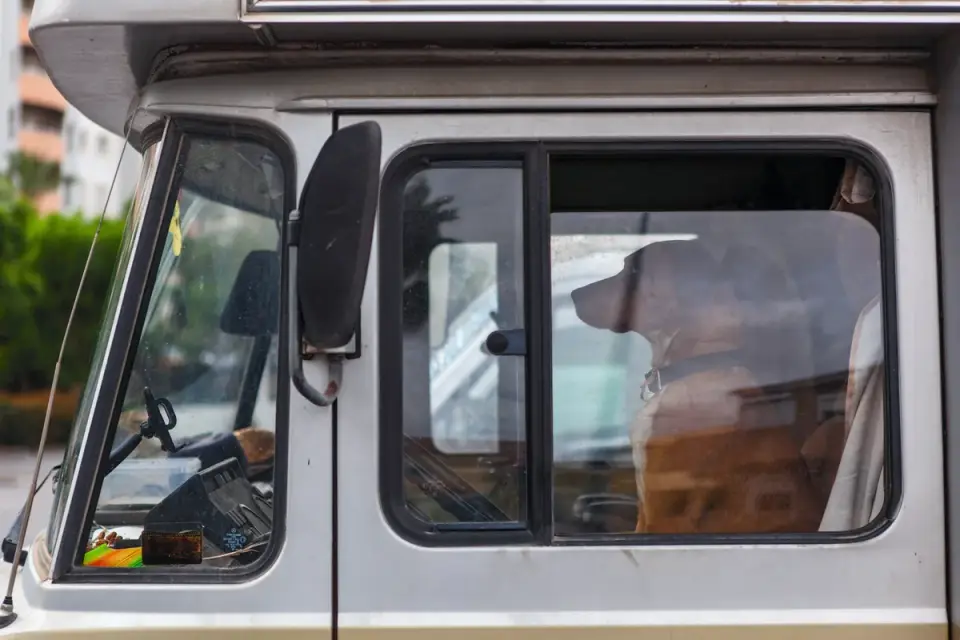
I’ve counseled a lot of clients before their first big rig trip, and I always start the same way: expectation first, gear second. An RV is not a house on wheels when the engine and AC are off. It’s a metal box that heats up fast, and a dog left inside it — even for “just a quick grocery run” — is at real risk. The American Veterinary Medical Association is blunt about this: never leave a pet alone in a parked vehicle, regardless of outdoor temperature or how long you expect to be gone, because interior temperatures climb fast and cracked windows or a running AC unit aren’t reliable protection.
Myth vs. reality: “the RV has AC, so it’s fine”
Myth: running the roof AC or leaving a window cracked keeps the rig safe for a dog left behind.
Reality: generators can fail, propane-powered AC units can shut off, and shore power isn’t guaranteed at every stop. If the cooling system stops for any reason while you’re at the visitor center or the trailhead, your dog has no way out and no way to tell you. I tell clients to treat an RV exactly like a parked car for this one purpose: if you can’t bring the dog, the dog doesn’t stay behind unsupervised, full stop.
One family I worked with had a seven-year-old Golden Retriever named Duke, about 68 pounds, who’d never shown heat sensitivity at home. On a July trip through the Southwest, they left him in the RV with the roof AC running while they hiked a short overlook trail. The generator cut out roughly forty minutes in — they didn’t know until they got back and found him panting hard, drooling, and reluctant to stand. He recovered with prompt vet care, but it reset how that family planned every stop afterward: one adult always stays with the rig, or the dog comes along, no exceptions.
Before you go: the sequence I walk clients through
- Map your stops around dog access, not just fuel and food. Decide in advance which stops the dog joins and which ones require someone staying behind with him.
- Pack a battery- or solar-backed temperature monitor for the RV interior if you’ll ever leave the dog inside for even a few minutes, so you have a real number instead of a guess.
- Bring a collapsible bowl and a case of water you trust, rather than relying on campground taps or natural water sources for drinking.
- Set up the crate or seatbelt harness before departure day, not the morning of, so the dog has already accepted it. Allow time for your dog to adjust to the crate before your trip.
- Withhold a large meal in the hours before a long driving day if your dog has any history of car sickness, and crack the windows a few inches while moving to help equalize pressure.
Water and trail exposure: the risk that’s easy to miss
Campground stops usually mean off-leash sniffing near streams, ponds, or shared water sources, and that’s where a second, quieter risk shows up. Dogs can pick up giardia from water contaminated with feces — their own species’ strain, not usually the one that makes people sick, but it still causes real gastrointestinal illness in a dog. The CDC notes dogs get giardia by drinking or eating something contaminated by feces, including grass a dog might sniff or lick along a trail.
I don’t tell clients to avoid natural water entirely; that’s not realistic on a road trip. I tell them to bring their own water for drinking and to discourage nose-deep exploring at stagnant ponds specifically. If your dog develops loose stool, gas, or a dull appetite a few days after a trip through backcountry water sources, that timeline matters. Mention it to your vet.
Motion sickness and the long-haul drive
RV trips mean longer stretches in motion than a typical car ride, and that raises the odds of motion sickness showing up even in dogs who’ve never had it. A solid-sided crate limits how much motion a dog sees out the window, which can lower the visual triggers behind car sickness, and it also contains any mess if sickness happens anyway. Positioning matters too — a crate placed low and central experiences less sway than one near the back of the rig.
If your dog is naturally anxious about new environments or unfamiliar stops, that’s worth planning around separately from motion sickness. Structure and low-stress handling strategies help dogs manage new environments and foot traffic in RV parks.
Where I land, and the trade-off I won’t pretend away
My recommendation is straightforward: treat the RV’s climate control as a system that can fail, not a guarantee, and build your day around that assumption. That means one adult occasionally sacrifices a hike or a museum stop to stay with the dog, or you find dog-friendly versions of those stops instead. I know that’s a real trade-off against spontaneity, and some traveling families will push back — “we have a generator monitor, we’ll be fine.” Backup systems reduce risk; they don’t eliminate it, and generators and AC units do fail in the field. I’d still rather a client build in the slower, safer plan than bet a dog’s safety on equipment holding up perfectly every single time.
The families who do this well aren’t the ones with the most gear. They’re the ones who planned the dog’s day with the same seriousness as the route, checked the water plan before the itinerary, and treated a crate and a temperature monitor as core equipment rather than an afterthought. That mindset carries a lot further than any single product does.
Before a first-time RV trip, it’s also worth reviewing broader trip logistics — timing, paperwork, and feeding gear — by planning feeding gear and trip timing in advance.
For related context, read Can You Travel With a Dog in Heat? What Actually Matters.
For related context, read Collapsible Bowls and Feeding Gear for Traveling Dogs.
Frequently asked questions
Is it ever okay to leave a dog alone in a parked RV with the AC running?
Vets generally advise against it. AC and generator systems can fail without warning, and a dog left inside has no way to signal distress or escape if cooling stops.
Can my dog get sick from drinking campground pond or stream water?
Yes, water contaminated by feces can carry giardia and other organisms that cause digestive upset in dogs. Bringing your own drinking water is the safer default on the road.
Sources
- Pet safety in vehicles — American Veterinary Medical Association
- About Giardia and Pets | Giardia — CDC